A device fingerprint tells you which browser arrived. It says nothing about who is using it, or whether anyone is. Fraud farms know this. They rotate devices, networks and accounts between entries, so each entry can look like a new visitor.
What they can't rotate as easily is how the page gets used. A person reads, hesitates, moves toward a button and changes their mind. A script fills each field in turn at a steady pace. A paid click-worker on their two-hundredth form of the day sits somewhere in between. Behavior tracking records that difference, and it feeds every Authentiq verdict.
What we record
With behavior tracking on, the SDK records how the visitor interacts with your page:
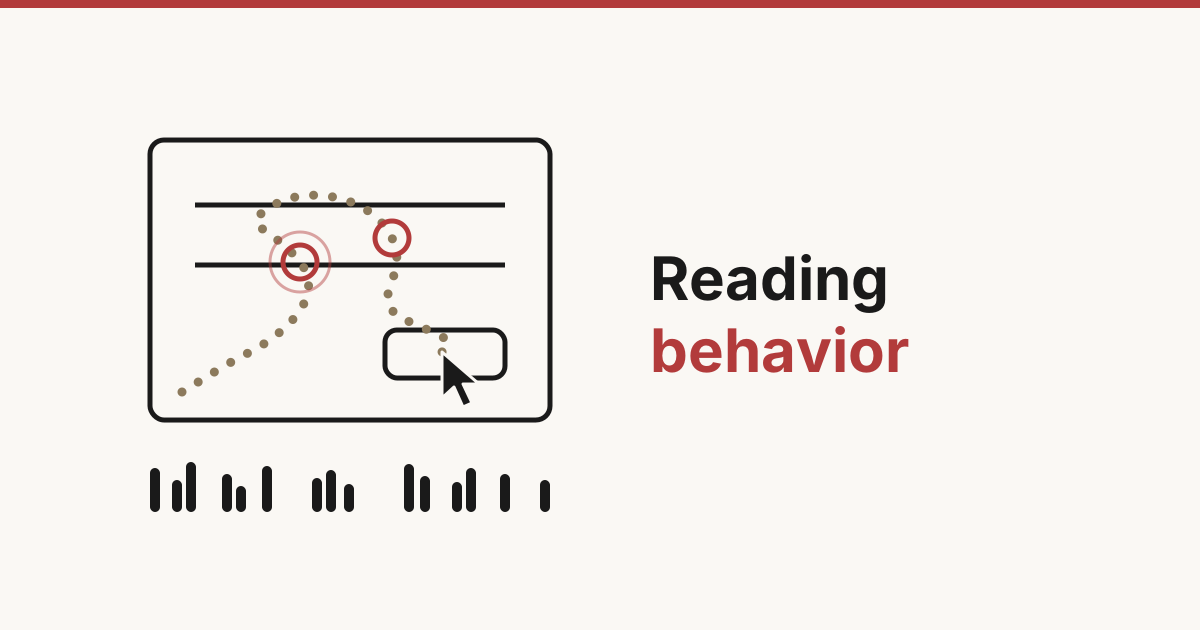
- Pointer and touch. How the mouse or finger moves, where it stops, how clicks and taps land, and how the page is scrolled.
- Typing rhythm. When keys go down and come up, never which keys.
- Form filling. Which fields were visited and in what order, how long each one took, whether text was typed, pasted or filled in by the browser, and which fields were corrected or failed validation.
- Actions. The buttons, links and answers clicked, and the moves between pages, as a timeline.
On a multi-page flow, such as a sign-up spread over several pages or a long questionnaire, all the pages count as one visit. The whole journey is read, not only the last page.
What we never record
We don't record what anyone types. No field values, no passwords, no answer text: only counts and timing, and whether text was typed, pasted or filled in. Button and link labels are checked for personal data before they are stored, and anything that looks like it is removed.
How a session is read
Each kind of input is summarized and compared with how people actually use pages, separately for desktop and mobile, since a thumb and a mouse leave very different traces. Some patterns stand out:
- A straight line through the form. Every field visited once, in order, at the same pace, with nothing in between. People skip ahead, go back and fix things.
- Answers without typing. Text that lands in field after field without the keys to produce it, or a whole form finished in the time it takes to read the first question.
- Movement that doesn't look like a hand. Clicks that land without the pointer travelling to them, and paths that are too straight and too even.
- Nothing at all. A form submitted with no movement, no scrolling and no keys.
None of these settles a visit on its own. A fast typist, a password manager or a screen reader can each produce one of them. So behavior is scored as a whole, and combined with everything else we know about the visit: the device, the network, and its history across visits.
Too little to go on is not held against anyone. A visit with nothing to measure reads no data and leaves the verdict alone.
When the farm is people
Some farms aren't scripts. They are people paid to fill in forms quickly, and their behavior looks human because it is. Behavior then shows a hurried person rather than a machine, and the rest of the verdict carries the weight: one device behind many accounts, one network behind many visitors, entries arriving in bursts. That is why behavior is one factor among several, and never the whole verdict.
Turning it on
Behavior tracking is an SDK setting. In the Authentiq docs, see SDK Reference → Authentiq.init(config) to switch it on, and Authentiq.complete() for closing the session before you retrieve the verdict.